
Between Critique and Imagination
There are moments in an academic journey that feel oddly like homecomings. The European Conference on Critical Edtech Studies (ECCES) is one of them. As I prepare to join this inspiring gathering in Zürich, I feel a quiet sense of excitement—not just because I’m presenting, but because I’ll finally meet many of the brilliant people whose work I’ve been reading, quoting, and challenging for years.
ECCES is not a mainstream event. And that’s exactly why it matters. It brings together scholars and practitioners working from the margins—those resisting the dominant narrative that “technology is inherently good”. Those questioning techno-solutionism not to halt progress, but to remind us that ethics, inclusion, and justice must be more than footnotes in policy agendas.
When Quantitative Becomes Critical
My contribution to ECCES 2025 is, at first glance, an odd fit. I’m bringing in a quantitative study: topic modeling, logistic regression, statistical inference. Yes, numbers. And this raises a tension I want to explore publicly. Can one work with quantification while critiquing datafication? Isn’t that oxymoronic?
Maybe. But I’ve come to believe that quantification is a form of representation. It has its own semiotics, its own constraints. The problem isn’t counting per se—it’s forgetting that we are the ones choosing what and how to count. I stand with those who engage in the hermeneutics of quantification: reading numbers not as truth, but as texts.
Projects like Dear Data have shown us that data can be artful, personal, human. Out of platforms and of certain forms of control, I argue. In this spirit, I use quantitative methods not to flatten reality into variables, but to reveal patterns in how ethical discourse emerges—or fails to emerge—in EU-funded EdTech projects.
I engaged in a rich dialogue with Diego Calderón-Garrido, and we soon found ourselves in an epistolary exchange similar to that of two “data-bricoleurs”—reflecting on the complex dance between discourse and token, and token and discourse. How could we make sense of the patterns emerging from the vast dataset we had gathered—3,204 EU-funded Erasmus+ projects spanning from 2014 to 2024? It all began with my close reading of project texts, hoping to uncover the underlying currents of EU policy on the ethics of AI and data. This inquiry turned into a collaborative reflection on us trying to wear the shoes of critical researchers…Here is our exercise, navigating approaching our study object through text mining and discourse analysis, between structure and meaning.
Our dialogue crystallised into a publicly accessible RPubs open script, available here, as a gesture of our shared commitment to open science. For us, practicing openness means more than transparency or reproducibility: it means thinking with others, sharing the tools of critique, and inhabiting the tensions of knowledge production with humility. In publishing the script, we are not only showing our code—we are showing our method, our doubts, and our evolving ethics of collaborative inquiry.
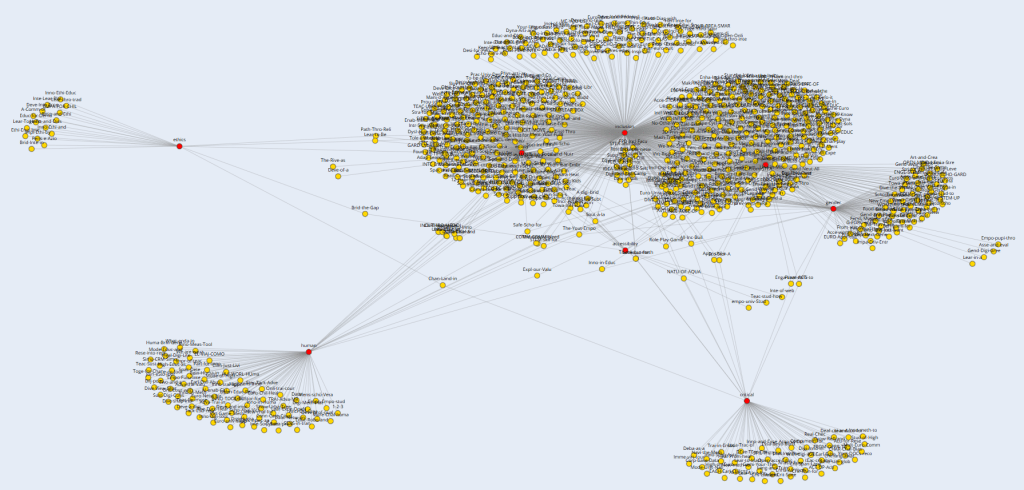
And here is yet another playful trial. Do you want to explore our dataset of projects yourself? Just go to our interactive map!
Our Findings
What we’ve discovered is both promising and sobering. Ethics and equity are gaining visibility in funded educational innovation—especially post-2020—but they are often framed as competences to be acquired, rather than frameworks for structural critique. In AI-related projects, ethical considerations are weaker, pointing toward a techno-solutionist drift.
Meanwhile, themes like inclusion, gender, and freedom tend to appear when we talk about who is “lagging behind,” not about power or justice. This framing subtly reinforces the idea that it’s individuals—not systems—that must be “fixed.”
Beyond Critique
And yet, ECCES is not just a space for critique. What I find most energising is that this community is also beginning to critique the critique—to imagine what lies beyond dismantling.
Could we reimagine education in relation to technologies not as neutral but as spaces for battle, resistance, co-creation, and political engagement?
You might say I expect too much…Maybe. I need to expect too much in the present we’re navigating.
To live a life full of ECCES, in these terms, means to critically deconstruct EdTech, as an expression of ethics, as an ethical practice. I look forward to every conversation, disagreement, and moment of silent reflection. I want to listen to the brilliant people I know there will be there. I guess it is only through joint human imagination and our stubborn distrust of what we are told to trust, that another EdTech is possible.
 En el jardín net